NECO Practical Specimens 2026/2027 For all Science Subjects
The NECO Practical Specimens 2026/2027 All science subjects, including biology, chemistry, physics, and agricultural science, typically focus on core identification and experimental setups, similar to previous years’ requirements. Materials often include specimens like snails, house flies, plant materials, titration apparatus, spring balances, and agricultural tools.
The National Examination Council (NECO) has officially published its 2026 NECO practical specimen/instructions for schools to prepare for the NECO June/July SSCE for school candidates. The NECO 2026 practical specimen is now available and can be accessed below.
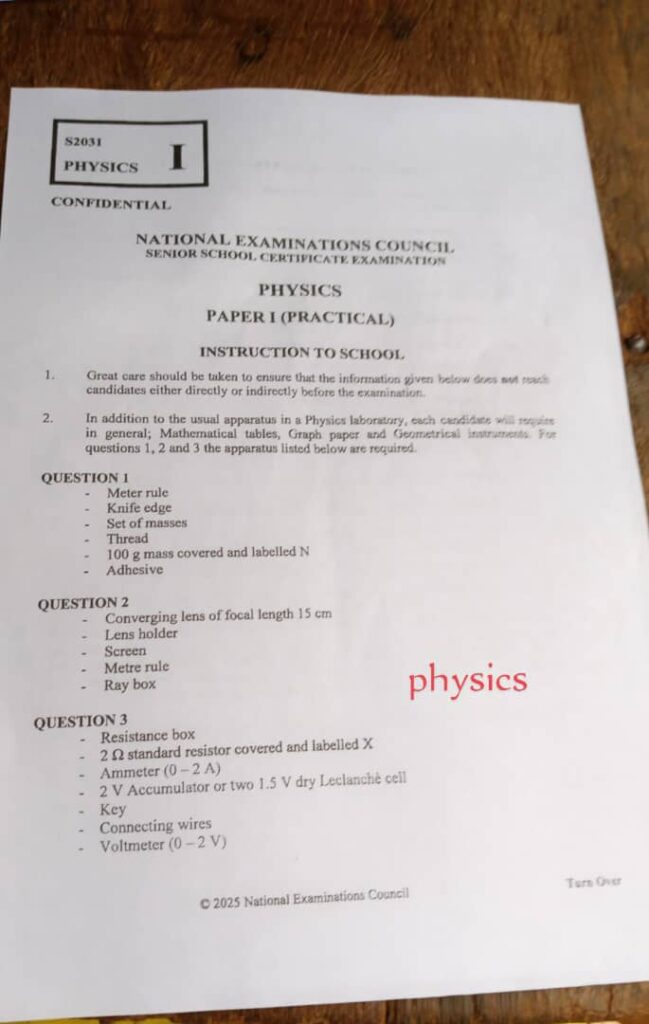
NECO Physics Practical Specimen 2026/2027
1. Adequate measure should be taken to ensure that the information given below does not reach the candidates either directly or indirectly before the Examination.
2. In addition to the usual apparatus in a physics laboratory, each candidate will require mathematical tables and geometrical instruments. In questions 1, 2 and 3, the apparatus listed below are required.
QUESTION 1
- Meter rule
- – Knife edge
- – Set of masses
- – Thread
- – 100 g mass covered and labelled N
- – Adhesive
- QUESTION 2
- – Converging lens of focal length 15 cm
- – Lens holder
- – Screen
- – Metre rule
- – Ray box
- QUESTION 3
- – Resistance box
- – 2 ? standard resistor covered and labelled X
- – Ammeter (0 – 2 A)
- – 2 V Accumulator or two 1.5 V dry Leclanché cell
- – Key
- – Connecting wires
- – Voltmeter (0 – 2 V)
CONDUCT OF THE PHYSICS PRACTICAL TEST
3. The following announcements should be made to the candidates at the beginning of the examination.
“The Examiner does not want you to waste your time because you cannot proceed with an experiment. Any candidate, therefore, who cannot get on with the experiment, after spending ¼ hour on it should call on me and ask for help”.
4. The Physics teacher is allowed to give a hint to any of the candidates who is unable to proceed with the experiment.
5. The following regulations must be strictly adhered to:
(a) No hint may be announced to the candidates as a whole
(b) A candidate who is unable to proceed and requires assistance must call on the teacher and state his/her difficulty
(c) The candidate(s) should be told that the Examiner will be informed of any assistance given in this way
(d) A note must be made on the Report Form of any assistance given to any of the candidates with the name and examination number of the candidate.
REPORT FORM
6. The Report Form is provided separately on which the following should be stated:
(a) Detailed information about the apparatus where necessary
(b) Any particular difficulty experienced by any of the candidates, especially if the Examiner would be unable to discover this from the script
(c) Any departure from the specified items which could not be avoided
(d) Any assistance given to the candidate(s) under the regulations explained in “5”.
7. Where several sets of apparatus are provided for a question and specific information about the apparatus is required by the Examiner, each piece of apparatus must be clearly marked with letters A, B, C, D, etc. Also, the corresponding information must be clearly reported, showing which apparatus was supplied to which candidate. The candidate(s) should be instructed to record these letters on their script(s).
8. The teacher must enclose a completed Report Form in each envelope of scripts.
NECO CHEMISTRY Practical Specimen 2026/2027
1. Great care should be taken to ensure that the information given below does not reach the candidates either directly or indirectly before the examination.
2. In addition to the apparatus and reagents expected to be available in a Secondary School Chemistry Laboratory, each candidate will require the following:
(a) One burette (50cm³)
(b) One pipette (20cm³ or 25 cm³), however, all candidates in a centre must use pipettes of the same volume.
(c) The usual apparatus and reagents for qualitative work include:
(i) Dilute sodium hydroxide solution
(ii) Dilute ammonia solution
(iii) Dilute hydrochloric acid
(iv) Barium chloride solution
(v) Distilled water
(vi) Red and blue litmus papers
(vii) Potassium tetraoxochromate (VI)
(viii) Potassium heptaoxomanganate (VII)
(ix) Phenolphthalein
(x) Five test tubes
(xi) Methyl orange
(xii) One boiling tube
(xiii) Filtration apparatus
OTHER INSTRUCTIONS
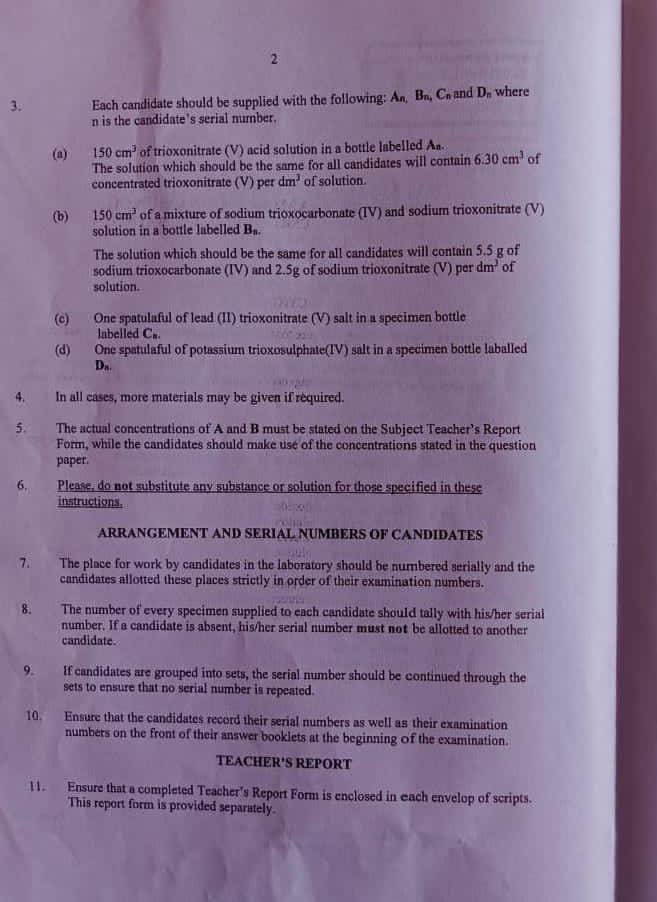
3. Each candidate should be supplied with the following: A?, B?, C?, and D?, where n is the candidate’s serial number.
(a) 150 cm³ of trioxonitrate (V) acid solution in a bottle labelled A?.
The solution which should be the same for all candidates will contain 6.30 cm³ of concentrated trioxonitrate (V) per dm³ of solution.
(b) 150 cm³ of a mixture of sodium trioxocarbonate (IV) and sodium trioxonitrate (V) solution in a bottle labelled B?.
The solution which should be the same for all candidates will contain 5.5 g of sodium trioxocarbonate (IV) and 2.5 g of sodium trioxonitrate (V) per dm³ of solution.
(c) One spatulaful of lead (II) trioxonitrate (V) salt in a specimen bottle labelled C?.
(d) One spatulaful of potassium trioxosulphate (IV) salt in a specimen bottle labelled D?.
4. In all cases, more materials may be given if required.
5. The actual concentrations of A and B must be stated on the Subject Teacher’s Report Form, while the candidates should make use of the concentrations stated in the question paper.
6. Please, do not substitute any substance or solution for those specified in these instructions.
ARRANGEMENT AND SERIAL NUMBERS OF CANDIDATES
7. The place for work by candidates in the laboratory should be numbered serially, and the candidates allotted these places strictly in order of their examination numbers
8. The number of every specimen supplied to each candidate should tally with his/her serial number. If a candidate is absent, his/her serial number must not be allotted to another candidate.
9. If candidates are divided into sets, the serial numbers should be continued through the sets to ensure that no serial number is repeated.
10. Ensure that the candidates record their serial numbers as well as their examination numbers on the front of their answer booklets at the beginning of the examination.
TEACHER’S REPORT
11. Ensure that a completed Teacher’s Report Form is enclosed in each envelope of scripts. This report form is provided separately.
NECO Biology Practical Specimen 2026/2027
1. The information contained here is highly confidential. Therefore, efforts should be made to avoid candidates getting to know of this either directly or indirectly before the examination.
2. Each candidate should bring to the examination hall/ laboratory:
(a) sharpened drawing pencil (HB)
(b) an eraser
(c) a ruler
3. The school should provide the following for the candidates:
(a) a sharp razor blade or scalpel
(b) petri-dish
(c) hand lens
4. Candidates should be provided with the following specimens during the examination:
A – Housefly
B – Spider
C – Pride of Barbados Flower
D – Bean seed
E – Butterfly
F – Crayfish
G – Grasshopper
H – Humerus of a Rabbit
I – Femur of a Rabbit
J – Orange Fruit
K – Honey Bee
L – Land Snail
M – Guava Fruit
N – Irish Potato tuber
O – Sweet Potato tuber
5. If it is not possible to provide each candidate with all the specimens and apparatus, a set of specimens can be provided for groups of not more than ten (10) candidates.
TEACHER’S REPORT
(i) This report proforma should be released to the teacher who will set up the practical’s for the candidates on the day of the examination.
(ii) A completed teacher’s report form must be enclosed in each envelope of scripts being returned to the Council.
(iii) On the report form, the teacher is requested to:
(a) Supply all necessary information with regard to the type of specimens provided.
(b) Report any general difficulty regarding the procurement of the specimen
(c) Report any particular problem experienced by any candidate during the examination.
NECO Agric Science Practical Specimen 2026/2027
1. Great care should be taken to ensure that the information given below does not reach the candidates either directly or indirectly before the examination.
2 (a) The provision of specimens, materials, and equipment for the examination is your responsibility.
(b)i. Each candidate should be provided with the following specimens labelled accordingly:
A – BURDIZZO
B – FILE
C – MANURE DRAG
D – GRANITE
E – CALCIUM CARBONATE
F – SIEVE
G – KOLANUT
H – SWEET POTATO
I – TICK
J – LOUSE
K – MEAT (FRESH)
ii. Where a specimen is not readily available in sufficient quantity, it should be shared between small groups of candidates.
REPORT FORM
The report form is provided separately on which the following information must be stated:
(a) Details of the specimens and materials provided,
(b) Any difficulty experienced by candidates especially if the examiner would not be able to discover it from the scripts.
4. A completed report form must be enclosed in an envelope containing the scripts.
NECO Animal Husbandry Practical Specimen 2026/2027
1. Great care should be taken to ensure that the information given below does not reach the candidates either directly or indirectly before the examination.
2 (a) The provision of specimens, materials, and equipment for the examination is your responsibility.
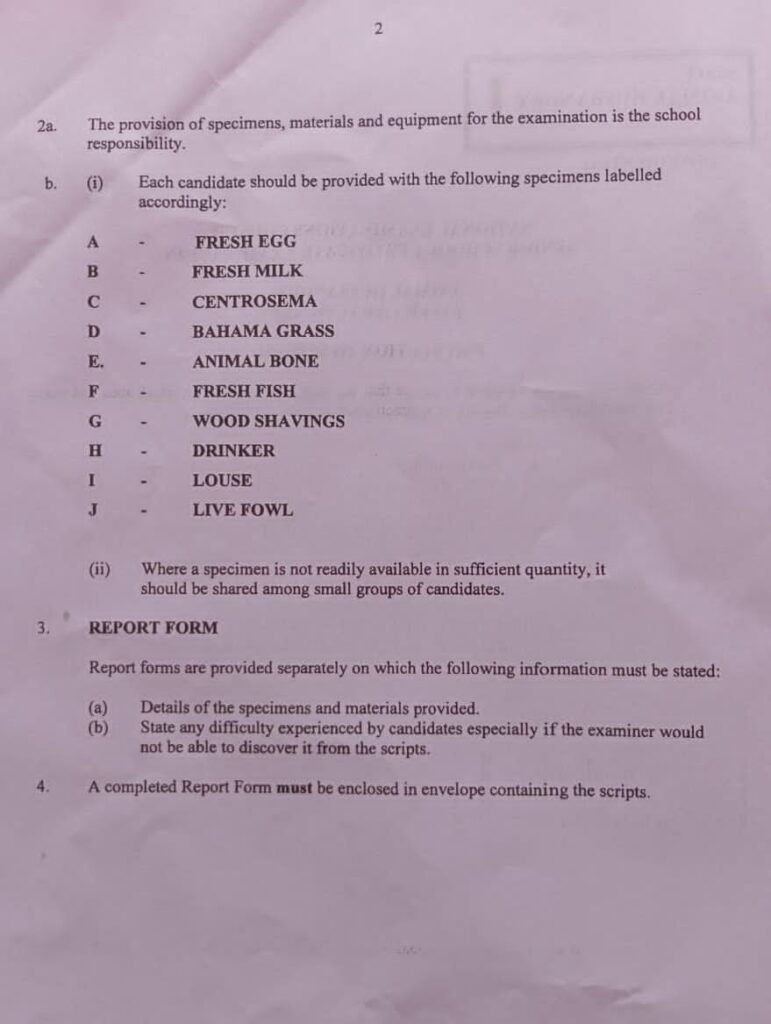
(b)i. Each candidate should be provided with the following specimens labelled accordingly:
A – FRESH EGG
B – FRESH MILK
C – CENTROSEMA
D – BAHAMA GRASS
E – ANIMAL BONE
F – FRESH FISH
G – WOOD SHAVINGS
H – DRINKER
I – LOUSE
J – LIVE FOWL
ii. Where a specimen is not readily available in sufficient quantity, it should be shared between small groups of candidates.
REPORT FORM
The report form is provided separately on which the following information must be stated:
(a) Details of the specimens and materials provided,
(b) State any difficulty experienced by candidates especially if the examiner would not be able to discover it from the scripts.
4. A completed report form must be enclosed in an envelope containing the scripts.
Conclusion
The NECO Physics Practical instructions emphasize strict confidentiality, proper laboratory setup, and fair examination conditions. Candidates are required to perform three main experiments:
a mechanics experiment based on the Principle of Moments using a meter rule and masses, an optics experiment involving a converging lens to study Refraction and determine focal length, and an electricity experiment based on Ohm’s Law using ammeters, voltmeters, and resistors.
Candidates may request help if stuck after 15 minutes, but any assistance must be recorded and reported to ensure transparency during marking.
Across all subjects (Physics, Chemistry, Biology, Agric Science, and Animal Husbandry), the instructions focus on preventing exam leakage, ensuring each candidate receives properly labelled specimens, and maintaining accurate records through a report form.
For example, Chemistry involves titration and qualitative analysis, Biology focuses on identifying and drawing specimens like the Housefly, while Agric and Animal Husbandry require identification and uses of farm tools and animal materials. Overall, the guidelines ensure fairness, standardization, and proper assessment of practical skills in line with NECO examination standards.
Recent Posts
- NECO Result Grading System 2026/2027
- 2026 NECO Syllabus for All Subjects Download Free PDF
- Neco Timetable For Science Students 2026/2027
- How to Pass All the 9 Subjects in NECO 2026/2027
- How to Pass All the 9 Subjects in NECO 2026/2027
- NECO Timetable 2026/2027 Final For all Students
- How to Pass Neco Exams 2026/2027 in One Sitting
- NECO Results Portal 2026/2027
- NECO Expo 2026/2027: Questions And Answers (100% Sure & Verified)
- How to Check NECO Result 2026/2027 – Step-by-Step Guide
- NECO Registration Portal 2026/2027: Form, Fee, & Date
- NECO Registration 2026/2027: Guidelines, Requirements & Deadline
- NECO RUNZ 2026/2027-CLICK HERE TO SUBSCRIBE

NECO Registration 2026/2027: Guidelines, Requirements & Deadline

NECO Original Certificate 2026/2027 & Result Collection Guidelines

NECO Correction of Names & Payment Guidelines 2026/2027
About Author
